Pay-per-click (PPC) advertising can help small and mid-sized businesses reach potential customers quickly, generate targeted traffic, and create measurable opportunities for sales and leads. However, PPC results depend heavily on how well the advertising budget is planned and managed. Spending more does not automatically guarantee better results; businesses need to allocate their budget based on goals, audience, competition, conversion rates, and customer value.
A well-planned PPC budget gives businesses greater control over advertising costs while creating room to test campaigns and improve performance over time. Whether you are launching your first Google Ads campaign or managing an established paid advertising program, having a clear budget strategy can help you avoid unnecessary spending and focus investment on campaigns that contribute to your business objectives.
How to plan a PPC budget
Start your PPC budget planning by defining a specific objective. Your goal might be generating leads, increasing online sales, promoting a service, driving calls, or attracting visitors to a particular landing page. The objective determines which campaigns and metrics should receive priority.
Next, estimate the economics of your campaign. Consider your expected cost per click (CPC), conversion rate, and target cost per acquisition (CPA). For example, if your average CPC is $2 and you expect approximately 5% of clicks to convert, you would need around 20 clicks to generate one conversion, resulting in an estimated $40 advertising cost per conversion. Actual results will vary, but estimates like this provide a starting point for setting realistic budgets.
Your planning process should also account for seasonality, geographic targeting, competition, and available search volume. Rather than distributing your budget equally across every campaign, allocate more of it toward products, services, keywords, and audiences that have the greatest potential to support your goals. Review your assumptions regularly and adjust the budget as real campaign data becomes available.
PPC budget management
Effective PPC budget management means monitoring where your money is going and making adjustments based on performance. Set daily or monthly spending limits and regularly review campaign-level metrics such as impressions, clicks, CPC, conversion rate, CPA, and conversion value. These metrics can help you identify campaigns that are consuming budget without producing the desired outcomes.
Avoid making major changes based on a small amount of data. PPC performance can fluctuate, so allow campaigns enough time to collect meaningful information before making significant decisions. At the same time, do not let clearly inefficient campaigns continue spending indefinitely without review. Use negative keywords to reduce irrelevant clicks, refine audience and location targeting, pause underperforming elements when appropriate, and adjust bids or budgets based on your campaign objectives.
It is also important to distinguish between spending less and spending efficiently. A campaign with a higher CPC may still provide better business results if it consistently generates valuable customers. Budget management should therefore focus on the relationship between advertising costs and business outcomes rather than simply minimizing the amount spent.
PPC budget for small businesses
For small businesses, setting a PPC budget can be challenging because advertising funds are often limited. Instead of choosing a budget based solely on what competitors appear to be spending, start with your business objectives and determine how much you can comfortably invest while maintaining other essential marketing activities. Consider factors such as your average customer value, profit margin, expected conversion rate, and the cost of acquiring a new customer.
It is often useful to begin with a controlled test budget rather than committing a large amount immediately. This allows you to gather data about keywords, audiences, click-through rates, conversion rates, and cost per acquisition. Once you understand which campaigns and keywords are producing meaningful results, you can gradually increase spending in those areas. Keep some budget available for testing new keywords, ad variations, landing pages, and audiences so your campaigns can continue to improve.
Paid advertising budget strategy
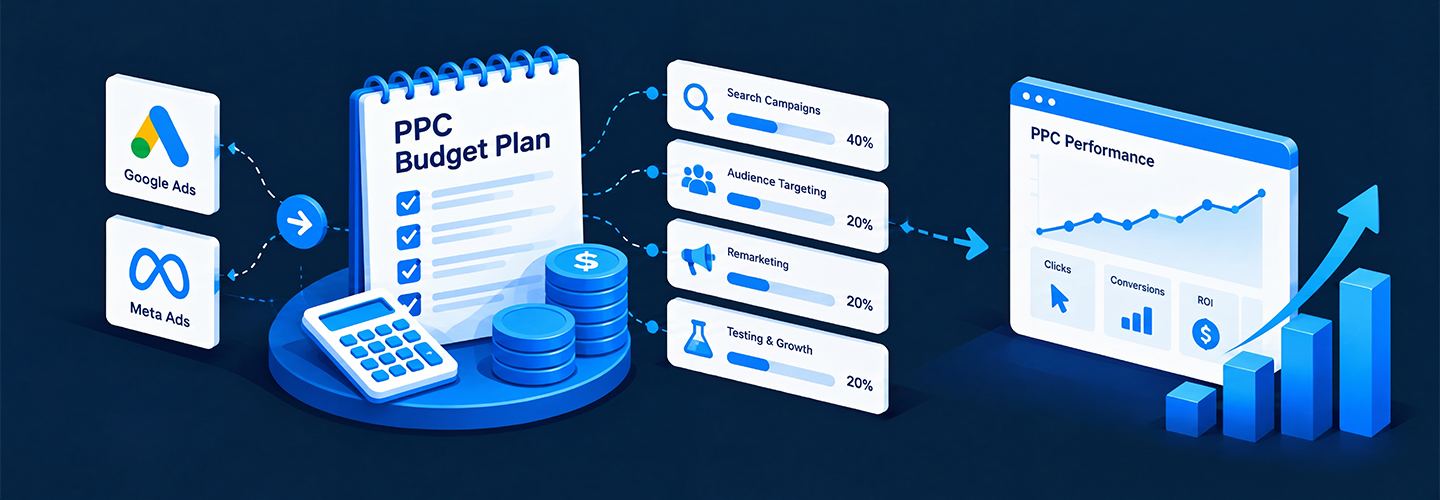
A strong paid advertising budget strategy should balance proven campaigns with controlled experimentation. Start by allocating the largest portion of your available budget to campaigns that directly support your primary business goals and have sufficient performance data. Keep a smaller portion available for testing new keywords, ad copy, audiences, platforms, or offers.
You can also divide your budget according to the customer journey. Search campaigns targeting users with strong purchase or service intent may receive priority when conversions are the primary goal, while display, video, or remarketing campaigns can support awareness and re-engagement. The appropriate mix depends on your business model and customer journey.
Your strategy should remain flexible. If demand changes, a product becomes more profitable, or certain campaigns begin generating more qualified conversions, your budget allocation may need to change as well. Review your PPC budget regularly, monthly for established campaigns and more frequently during major launches or seasonal periods, and use performance data to guide adjustments.
PPC ROI optimization
PPC ROI optimization is about getting more business value from your existing advertising spend rather than simply increasing your budget. Begin by identifying the campaigns, keywords, ads, audiences, and landing pages that generate valuable conversions. Analyze not only the number of conversions but also their quality and revenue contribution.
Improving your landing pages can have a significant effect on campaign efficiency. Make sure landing pages match the intent of the advertisement, load quickly, work well on mobile devices, communicate the value proposition clearly, and provide a straightforward next step. Better alignment between keywords, ads, and landing pages can help improve the overall customer experience and make your advertising spend more productive.
Continue testing different ad messages, offers, calls to action, keywords, and landing-page elements. Track the results of these changes and use the data to guide future decisions. If your business can measure revenue or customer value, use those figures alongside metrics such as CPA and conversion rate to understand the true return from your PPC investment.
Budget optimization
Increasing a PPC budget makes sense when campaigns are consistently generating profitable results and there is sufficient additional demand available. Businesses should look for stable conversion volume, acceptable acquisition costs, strong lead or customer quality, and opportunities to capture more traffic before committing additional money.
If a campaign is already performing efficiently but is limited by budget, increasing spend can create additional volume. However, budget increases should generally be made gradually so that performance can be monitored and inefficient spending can be identified quickly.
Budget optimization also involves knowing when to reduce investment. Campaigns that consistently exceed acceptable acquisition costs, generate poor-quality leads, or fail to produce meaningful revenue should not continue receiving the same level of funding simply because they were previously allocated a budget.
Poor performance should first be investigated to determine whether optimization can solve the problem. If the issue is related to irrelevant targeting, weak advertisements, poor landing pages, or incorrect conversion tracking, those problems should be addressed. If the underlying market opportunity is simply not profitable at available costs, reducing or reallocating the budget may be the better decision.
Conclusion
A successful PPC campaign starts with a realistic budget and a clear understanding of what you want your advertising to achieve. Small and mid-sized businesses do not necessarily need enormous advertising budgets to build effective campaigns; they need a structured approach to planning, testing, managing, and optimizing their spend.
Start with a manageable budget, establish measurable goals, monitor performance consistently, and reinvest based on meaningful results. As your campaigns collect more data, you can make increasingly informed decisions about where to increase spending, where to reduce it, and which opportunities are worth testing next.