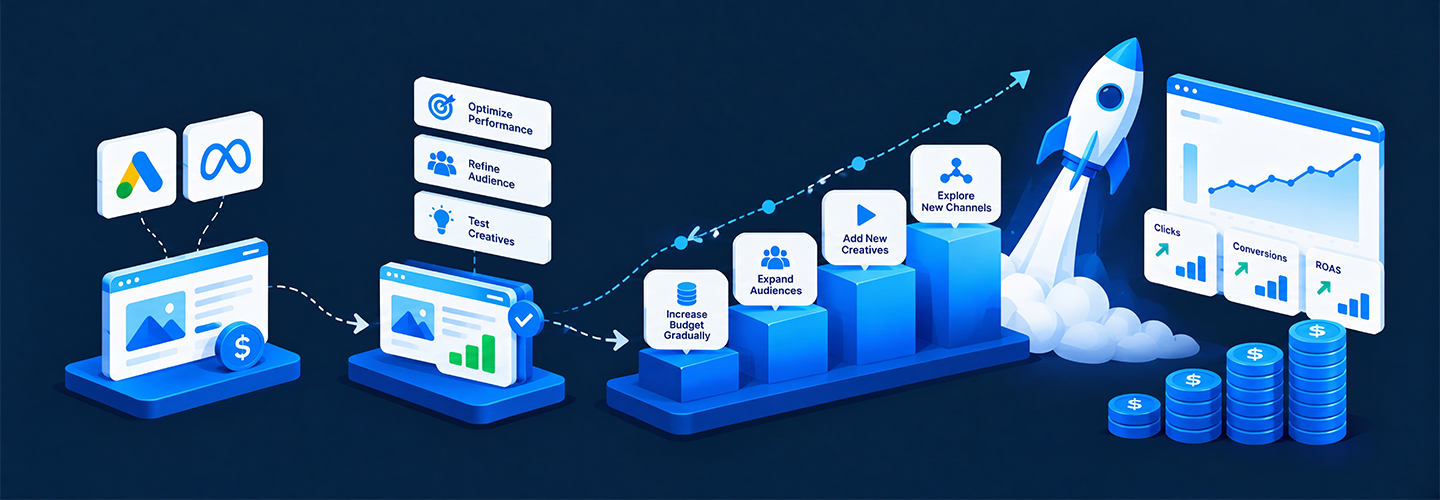
Scaling a paid advertising campaign can help a business generate more leads, sales, and revenue, but increasing ad spend too quickly can also result in higher acquisition costs and wasted budget. The goal of scaling is not simply to spend more money—it is to increase conversion volume while maintaining an acceptable cost per acquisition and return on investment.
A successful scaling strategy combines performance data, controlled budget increases, audience expansion, creative testing, and continuous optimization. Whether you are running Google Ads, Facebook Ads, or campaigns across multiple paid channels, scaling should be treated as a gradual process. By identifying what is already working and expanding it carefully, businesses can grow their campaigns without unnecessarily increasing costs.
Paid advertising scaling strategies
Before increasing your advertising budget, establish a reliable performance baseline. Review metrics such as conversion rate, cost per acquisition (CPA), return on ad spend (ROAS), click-through rate, average order value, and conversion volume. Scaling a campaign that is already inefficient can simply increase the amount of money being spent without producing proportional results. Fix major targeting, creative, landing-page, or tracking issues before attempting to scale.
One approach is to increase the budget gradually on campaigns that consistently meet your performance targets. Smaller increases allow you to monitor how performance changes without making a major financial commitment. You can also scale horizontally by expanding into new audiences, keywords, locations, products, placements, or advertising platforms rather than depending entirely on one campaign.
Creative expansion is another important part of scaling. As advertising spend increases, the same audience may see your ads more frequently, potentially causing engagement and conversion rates to decline. Develop multiple creative concepts, headlines, offers, and formats and test them systematically. Continue monitoring performance so that successful creatives can receive more budget while weaker variations are adjusted or replaced.
Cost-effective paid advertising strategies
Cost-effective paid advertising is about maximizing business value from your available budget rather than simply finding the cheapest clicks. Start by targeting audiences that have a strong connection to your product or service and make sure your advertisements accurately reflect what users will find after clicking. Clear targeting and relevant messaging can reduce wasted impressions while improving the likelihood of qualified traffic.
Your landing page also plays a major role in advertising efficiency. A campaign can generate plenty of clicks but still waste budget if visitors encounter a slow, confusing, or poorly optimized landing page. Make sure landing pages load quickly, work well on mobile devices, clearly communicate the value proposition, and provide an obvious next step. Align the landing page message with the advertisement so users immediately understand that they have reached the right destination.
Retargeting can also help businesses make better use of existing traffic. Users who have already visited your website or interacted with your business may require additional information or reminders before converting. Carefully structured remarketing campaigns can help re-engage these users while supporting the broader customer journey.
Finally, make optimization an ongoing process rather than a one-time task. Set clear performance targets for metrics such as CPA, ROAS, conversion rate, or customer acquisition cost, and review performance regularly. Avoid making major decisions based on short-term fluctuations alone. Test changes systematically, document the results, and reinvest in strategies that demonstrate sustainable performance.
PPC budget optimization strategies
PPC budget optimization starts with understanding where your advertising spend is generating meaningful business results. Analyze campaign, ad group, keyword, search-term, audience, and device performance to determine which areas consistently contribute to conversions. Once you have sufficient data, shift more budget toward productive campaigns while reducing spend on areas that generate irrelevant traffic or consistently miss your performance targets.
Negative keywords are particularly useful for controlling wasted search advertising spend. Regularly review search terms to identify irrelevant queries and add exclusions where appropriate. You can also analyze location, device, time-of-day, and audience performance to identify meaningful differences in results. These insights can help you make more informed budget allocation decisions.
Do not optimize solely for inexpensive clicks or a high number of leads. Conversion quality matters just as much as conversion volume. For example, a campaign that generates fewer leads at a higher CPA may deliver greater revenue than one producing many inexpensive but low-quality leads. Where possible, connect your advertising platforms with CRM and sales data so you can measure the downstream value of leads and customers.
Facebook Ads scaling strategies
Facebook Ads scaling requires careful attention to audience size, campaign structure, budget changes, and creative performance. Before increasing spend, identify campaigns and ad sets that have demonstrated consistent conversion performance and have enough data to support scaling decisions. Increase budgets gradually and monitor CPA, conversion volume, frequency, ROAS, and other relevant metrics as spending increases.
Audience expansion can create additional opportunities for growth. Depending on your campaign objectives, you can test broader targeting, lookalike audiences, remarketing audiences, or new customer segments. Broad audiences may give the platform more room to find potential customers, while narrower audiences can be useful when your product or service has a clearly defined target market. Test these approaches rather than assuming one targeting method will work for every campaign.
Creative testing becomes increasingly important as campaigns scale. Test different hooks, visuals, video formats, offers, headlines, and calls to action to identify what resonates with your audience. Monitor frequency and engagement alongside conversion metrics to recognize when creative fatigue may be affecting performance. Maintaining a steady pipeline of fresh, relevant creative can help your campaigns continue reaching users without relying too heavily on one advertisement.
Conclusion
Scaling paid advertising successfully requires a balance between growth and efficiency. Increasing budgets without a clear strategy can quickly increase costs, while controlled scaling gives businesses more opportunities to grow without losing sight of performance.
Focus first on campaigns that already demonstrate strong results, then expand gradually through higher budgets, new audiences, additional creative, and carefully selected channels. With consistent optimization and disciplined spending, businesses can scale their paid advertising campaigns while keeping unnecessary budget waste under control.