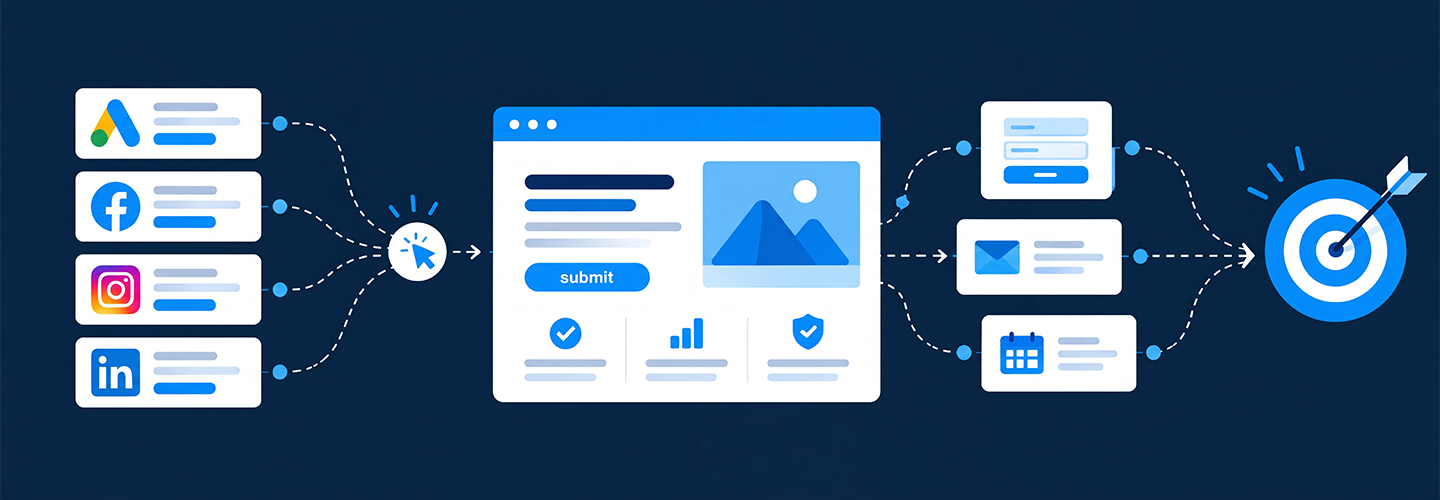
Paid advertising can bring highly targeted visitors to a website, but getting people to click an advertisement is only the first part of the conversion process. If a landing page is confusing, slow, poorly matched to the advertisement, or difficult to navigate, valuable paid traffic can leave without taking action.
This is why a well-optimised landing page is essential for a successful paid advertising strategy. The page gives visitors a clear reason to stay, understand the offer, and complete the desired action.
Whether the goal is generating leads, increasing sales, collecting enquiries, or encouraging sign-ups, the landing page needs to continue the message that brought the visitor there.
What is landing page optimization?
Landing page optimization is the process of improving a landing page so that a greater percentage of visitors complete the intended action. This can involve changes to a page's messaging, layout, headline, call to action, form, images, trust signals, mobile experience, loading speed, and overall user journey.
Every element should contribute to reducing uncertainty and making the next step obvious. When visitors immediately understand what is being offered, why it is relevant to them, and what they need to do next, the likelihood of conversion increases.
Landing page optimization is important for paid advertising because every visitor has a cost attached to their acquisition. Sending paid traffic to an ineffective page can increase the cost of generating leads or sales even when the advertising campaign itself is performing well.
Create clear and specific headlines
The headline is one of the first elements visitors see, so it needs to communicate the core value of the offer quickly. A vague headline can force visitors to read further just to understand what the page is about, increasing the possibility that they leave before engaging with the content.
A strong headline should clearly communicate what the visitor can get and why it matters. It should focus on the primary benefit or outcome rather than relying on generic promotional language.
The supporting copy should then provide enough information to reinforce the headline without overwhelming the visitor. The goal is to create a clear hierarchy where the headline establishes relevance, the supporting content explains the value, and the call to action provides the next step.
High-converting landing pages
A high-converting landing page can make the difference between an ad campaign that attracts clicks and one that generates real business results. Landing pages that improve ad conversions are designed around a clear goal: turning visitors into leads, customers, or subscribers.
Effective landing pages align closely with the ad that brought visitors there. The messaging, offer, and call to action should feel consistent, helping users immediately understand what they will gain. A compelling headline, concise copy, persuasive benefits, and a prominent call-to-action can guide visitors toward taking the desired action.
Speed and mobile responsiveness also matter. A fast, easy-to-navigate page reduces friction and creates a better experience across devices. Trust signals such as testimonials, reviews, security badges, guarantees, and relevant statistics can further reassure potential customers. To improve performance, test different headlines, CTAs, layouts, offers, and forms. Use conversion data to identify where visitors drop off and make informed adjustments.
PPC Landing Page
A PPC landing page should be designed specifically around the advertising campaign rather than simply sending paid traffic to a generic website page.
A dedicated page gives businesses greater control over the message, offer, content, conversion path, and tracking. It can also be aligned closely with the keywords, advertisements, audience, and campaign objective.
This is valuable when multiple advertising campaigns target different customer needs. Each campaign can direct visitors to a page that addresses the relevant intent instead of forcing everyone onto the same generic page.
A focused PPC landing page also makes testing easier because businesses can measure changes to the page against a specific campaign and conversion objective.
Optimize Google Ads landing page
A Google Ads landing page should maintain a strong connection between the search query, advertisement, and page content. The visitor should immediately see information that relates to the reason they clicked the ad.
Relevance is important for search advertising because users often arrive with a clearly defined need. If the landing page does not address that need quickly, the visitor may return to the search results and choose another option.
The page should therefore use clear messaging, relevant information, a focused CTA, and a straightforward conversion process. Businesses should also monitor landing-page performance alongside campaign metrics rather than treating advertising and landing-page optimization as completely separate activities.
Improving the landing page can increase the value of existing advertising traffic without necessarily requiring a larger advertising budget.
Landing page conversion rate
Your landing page conversion rate provides an important indication of how effectively the page turns visitors into leads, customers, or other desired actions.
A high conversion rate is not automatically positive if the conversions are low quality. Likewise, a lower conversion rate may still be commercially valuable if the resulting customers have high lifetime value.
Businesses should therefore monitor conversion rate alongside lead quality, customer acquisition cost, revenue, and other business metrics.
Tracking these metrics helps identify whether poor advertising performance is actually caused by the landing page. If an advertisement generates relevant traffic but visitors rarely convert, the landing page may be creating unnecessary friction.
Matching landing pages to intent
A landing page should reflect the specific intent behind the traffic generated by an advertising campaign. Visitors arriving from different ads may have different expectations, interests, and stages in the buying journey. Sending everyone to the same generic page can make the experience less relevant and reduce the impact of paid traffic.
For example, an ad promoting a specific service should lead to a page dedicated to that service rather than a broad homepage. Similarly, campaigns targeting different customer segments can benefit from landing-page content tailored to each audience's needs and search intent.
Keyword alignment is another important consideration. When the language used in an advertisement and its destination page closely relates to what a visitor searched for or responded to, the overall campaign experience becomes more cohesive. This relevance can also support stronger advertising performance and help visitors understand the connection between their initial interest and the available offer.
Conversion tracking provides another layer of insight. By measuring actions such as form submissions, purchases, downloads, or enquiries, marketers can understand which landing pages contribute to campaign objectives. This data helps connect advertising spend with actual business outcomes and provides a clearer basis for ongoing campaign decisions.
What ultimately improves Ad conversions
Improving ad conversions comes down to creating a landing-page experience that makes the desired action feel relevant, worthwhile, and easy to complete. While individual elements such as headlines, forms, page speed, and calls to action all contribute, their effectiveness depends on how well they work together around the visitor's intent.
The strength of the offer is particularly important. A well-designed page cannot compensate for an offer that does not provide enough perceived value. The landing page should make the benefit of taking action clear and demonstrate why the offer is worth the visitor's time, money, or information.
Reducing friction is equally important. Unnecessary form fields, unclear next steps, distracting content, technical issues, or unexpected requirements can interrupt the conversion journey. Removing these obstacles allows interested visitors to act without unnecessary effort.
Businesses should also evaluate conversions beyond the initial action. Tracking qualified leads, completed purchases, revenue, and customer value provides a more meaningful view of whether the landing page is supporting business objectives.
Conclusion
Improving ad conversion is not solely about creating better advertisements. The landing page is where the visitor ultimately decides whether to continue, enquire, purchase, or leave.
A strong advertising campaign can generate relevant traffic, but a weak landing page can prevent that traffic from producing meaningful business results. Landing page optimization closes this gap by improving the experience between the initial ad click and the final conversion.
When these elements work together, businesses can get more value from the traffic they are already paying for. Rather than simply increasing advertising spend to generate more visitors, improving the landing page can help turn a greater percentage of existing visitors into meaningful conversions.